Fifteen of us converged on Marilynn Clarke's home yesterday for a two-day natural dye workshop.
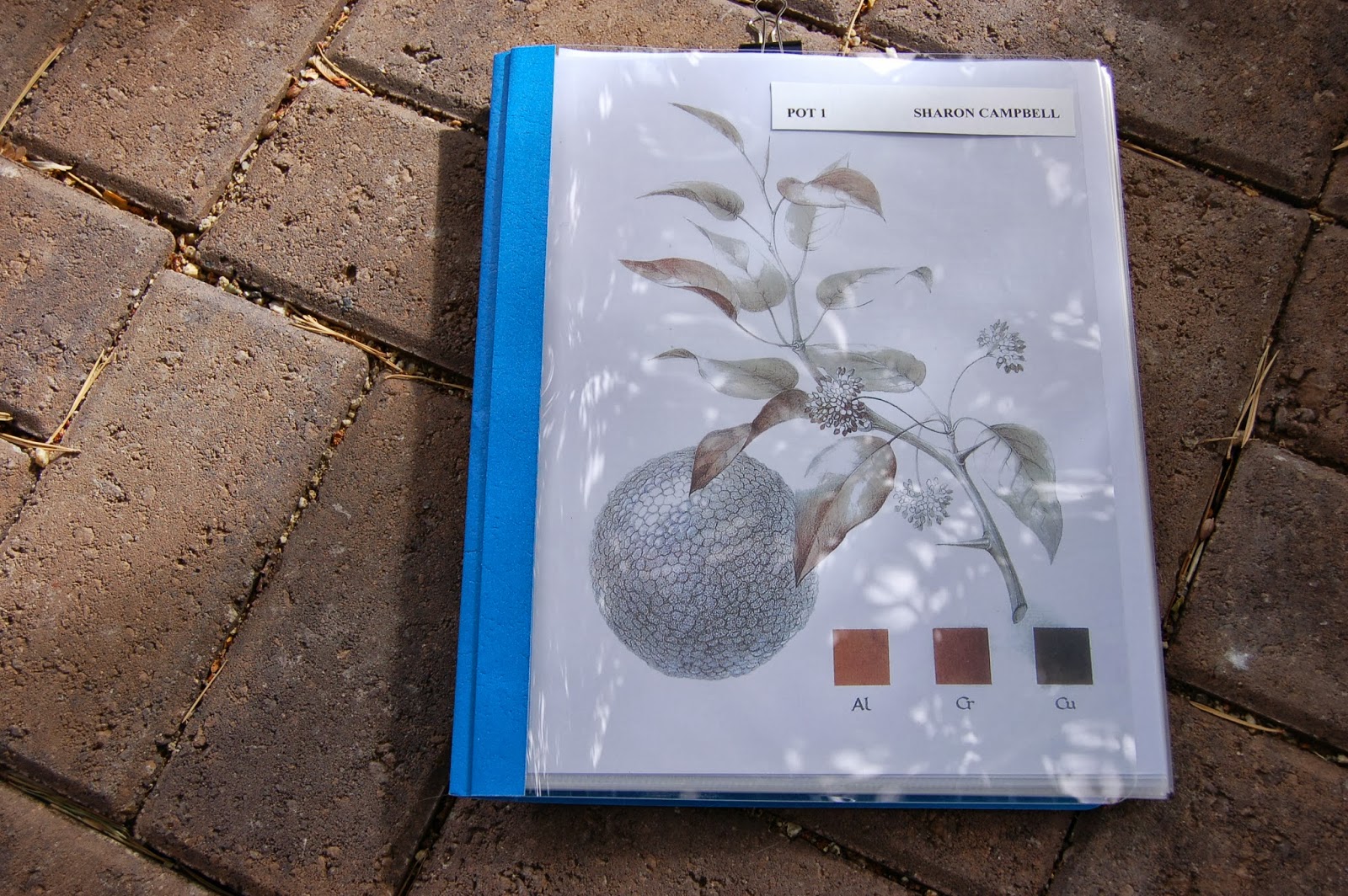
The text we used was prepared by her and guided us through all the steps we took. We started the morning with a brief lecture and explanation of the class. She is astoundingly knowledgeable and lucky me - she's a member of my own guild!
We were assigned a buddy and each team was responsible for a dye pot. She had prepared sheets for each pot with the calculations to achieve the intended results. For instance the Osage Orange and Madder pot, that team had to calculate what 30% of the weight of fiber was (we knew the weight) and mix 40% of that 30% in very hot water. The madder was 50% weight of fiber and they needed 60% of the 50%. Some of us struggled a little with the math, even with calculators.
The samples were pre-measured and soaking. Marilyn provided us the weights of the Merino wool yarn since they were wet and we couldn't weigh them ourselves.
We dyed the sample skeins in bundles of three, each looped together with a label identifying the pot.
The results were starting to come out of the pots. Sharie and I were assigned to pot #1 which was Osage Orange, measured at 30% weight of fiber. The two bright yellow skeins in the front are from our pot.
The third skein of each pot was assigned an after mordant. Ours was iron which turned the bright yellow into a wonderful sage green.
The post mordants had mixed results. Some were hard to see the change and others, like the samples on the front right were dramatic. That orange was Quebracho Red and Fustic but with the acetic acid after bath, it turned bright pink. Crazy!
We returned this morning and the first order of business was to attach labels from the bag of labels we received in our packets.
These are my samples from yesterday. Now that those were taken care of, we began today's dyeing and over-dyeing with indigo.
Again, we were dyeing three bundles. The first was a single dip of two minutes duration, the second was two dips for a total of four minutes and the third was three dips for six minutes. Marilyn said that you would just continue until you reached the desired depth of shade.
Into the Indigo Pot
And out! You can see it's already beginning to oxidize and turn blue.
This is the first of the indigo bundles. Max brought a silk blouse that she wanted to dye so that's it on the bottom rack. After all the skeins were dyed, she took off her jeans and put them in the pot. Good thing she was wearing a long tunic top!
The results were less diverse today than yesterday. I had some favorites though and one of them, a deep forest green, is on the bottom right, front row. It's the Osage Orange again.
These are all my samples and I could not be more pleased, with them or with the workshop. I had a blast, laughed a lot, made new friends and came away knowing that I can replicate these results, thanks to Marilyn's well-crafted workbook. Thanks Marilyn!!!!!
Sharon